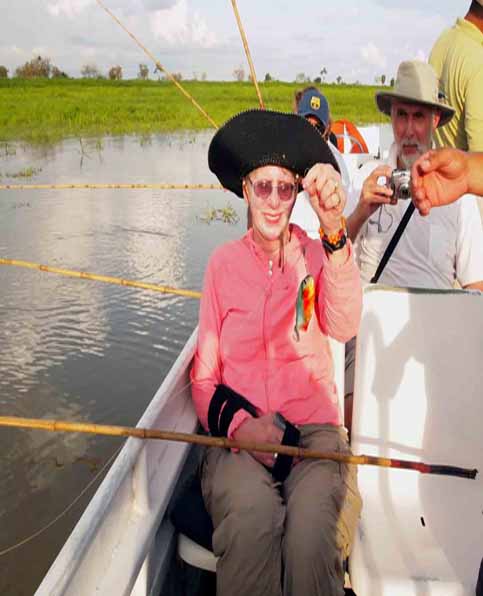
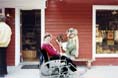
| Gingerly, Nancy checks the colorful piranha she just caught on the Amazon River, Brazil. |
What comes to your mind when you hear the words "Amazon River"? Having spent some time in the Amazonian Rain Forest in Ecuador, we instantly wanted to go to the river itself- which is in Brazil. Though not a country, the Brazilian Amazon is so special it demands a section of its own. And it also permits us to make a point to anyone with disabilities:
We are in our seventies, both of us are physically challenged, but that did not keep us from dreaming about exploring the Amazon. And so, for our Golden Wedding Anniversary, fifty years married, we did it. And if we can do it, you can, too. It was one of the most challenging trips we have taken, physically demanding and requiring lots of determination, but achievable, and well worth the effort. Attitude is 90% of the battle.
Historians say "The Amazon" starts as snow melt in the Andes Mountains of Peru, and also from sources in Columbia and Ecuador. All three countries are on the far West Coast of South America, on the Pacific Ocean side of the continent. They contribute to several huge river systems which collectively are known as the Amazon River. |
But the natives do not refer to it as the Amazon River until two of the major river systems come together at the city of Manaus, in the jungles of Brazil. |
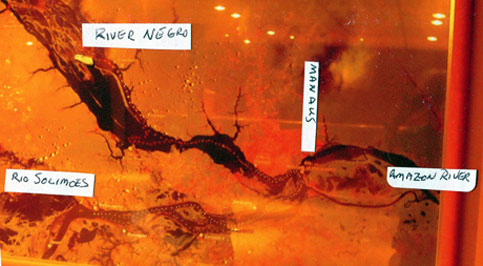
Google satellite photo of merging two river systems to form Amazon River
Except for being wet, the two rivers are totally different in almost every respect. Before Manaus, they flow separately, then flow side-by-side for 4 miles or so past Manaus, in the same channel, but still distinctly separate. Then the waters begin to intermix and flow as one river for the rest of the distance across the continent to empty into the Atlantic Ocean on the North Eastern Coast of South America, nearly a thousand miles beyond Manaus. To have a true Amazon adventure, you must explore both.
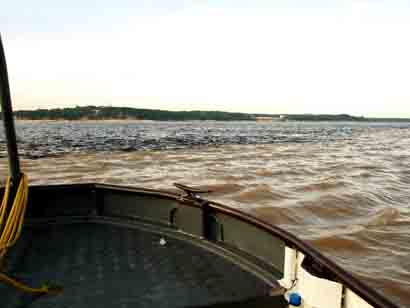
Photo: Two rivers, one brown (Solimoes), one black (Negro), running side by side in front of our boat.
There are no bridges over the Amazon, mostly because there are no cities to go to. Even Manaus, a city of over two million, is not connected by road to anyplace else in Brazil. There are only two ways to get to Manaus, you must either fly in- or take the river and arrive by boat.
Also, there are only two seasons here, wet and dry.
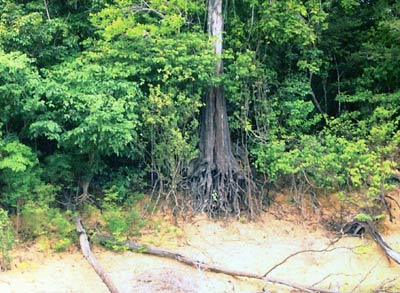
The rainy season starts the second week in November, so the river has been rising for about a month. The tree at center shows the high water mark about 15 feet up its trunk, although the tree is set well back from the present water edge.
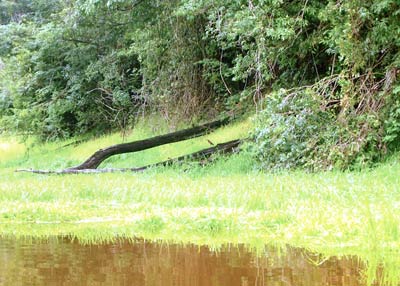
The water level will rise and fall about 40 feet between seasons. Here, we see the remnants of grasslands still above water. All of this will be under 15 or 20 feet of water in another 3 or 4 weeks. For now, we meander down the river surrounded by nothing but beauty, silence, and tranquility. There are animals living in these jungles, but with the water level so low, they are well inland, so we see nothing but birds.
In flood stage, the Amazon can be many miles across and hundreds of feet deep. In total, it carries the largest volume of water on the planet, almost 20% of all fresh water on Earth. It is a mighty river, indeed, irrespective of whatever statistics you use or what anyone says to the contrary.
About the two rivers:
The Rio Negro, is very "acidy" (with a pH around 4.2). It is home to many different species of fish, and before flood stage, has a lot of sandy beaches that serve as "home" to turtles which use these beaches to lay their eggs.
The other river, Rio Solimoes, is "neutral", with a pH of around 7.0, close to the pH of human blood. One river has a flow rate of about 1.5 mph, the other a flow rate more than three times faster.
The things that live and thrive in each river are totally different, as are the lives of the people who live along the banks, and in the villages and jungles of each river system.
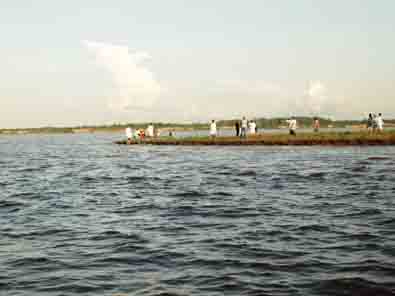
Photo: Baptism ceremony at point near where rivers meet to form The Amazon.
Where the two systems merge is thought to be a holy place, and religious ceremonies are held there. While we cruised in the area, we saw this Baptism being performed.
*******************************
Time to explore! Up early to take advantage of the cooler morning temperatures, Nancy is dressed and in her life jacket ready to rock 'n roll. We begin by determining the best way to get Nancy off the ship.
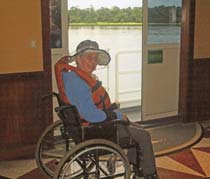 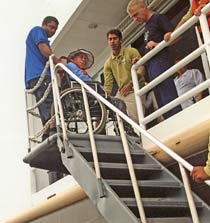
Augustus, the General Manager, decides to have Nan carried down the stairs to the waiting small boat. I purposely made this small so you cannot see the displeasure on Nancy's face!
We had done this years ago on our trip to Antarctica. It wasn't fun then- and it isn't now. Yet, if you are going to do the kinds of things we do, you have to learn to conquer fear. Still, I promise Nancy we will not do it again!
*****************************
Safely off the ship, we head down the river. The color of the water tells you we are on the Rio Negro. It also reaffirms the water level is still quite low. The dock at river's edge floats as the river rises and falls; note the houses high above it- and the sandy beach between them.
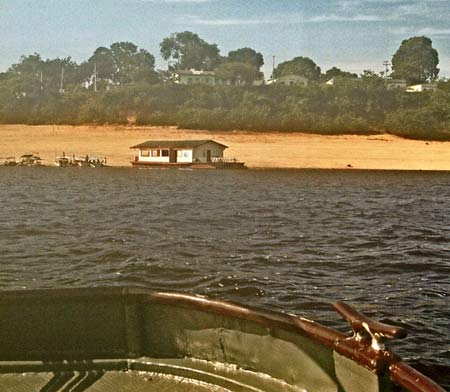
Photo: Approaching the dock and dolphin feeding station on Rio Negro
All the beach will soon be flooded, but for now, Nature has other plans. The sandy banks provide a place where Sea turtles come ashore in late October to lay their eggs. According to plan, these eggs will hatch just as the water levels rise in late November and December, making it easier (and safer) for the turtle hatchlings to return to the river.
As rugged and tough as the jungle seems, it is impossible not to be aware of the fragility of the environment. Everything here is interdependent and has a reason for being. You can imagine how easily things can be messed up by careless interference.
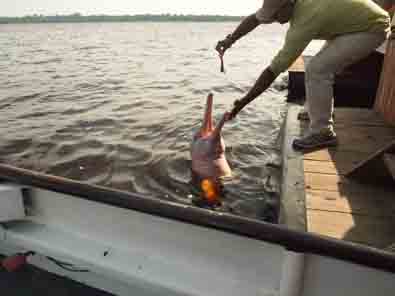
This particular place along the Rio Negro is where dolphins come to feed. They have also been "trained" by the natives to approach the platform to get food. |
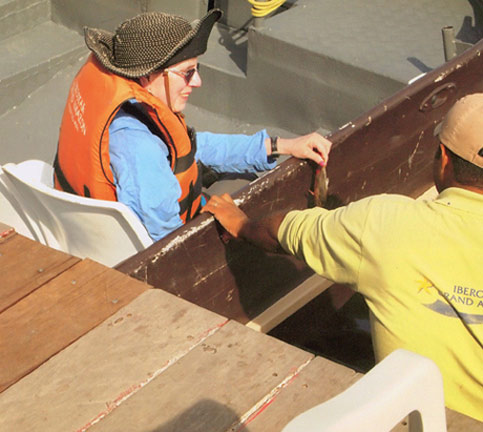
Nancy has no fear with animals, and expectantly holds a fish out as bait to attract a dolphin. Unfortunately, she gets no takers, but clearly she is enjoying the experience!
These are fresh water dolphins, pinkish in color, with a much longer mouth or "snout" than their saltwater cousins!
***********************
We have had a a joyous and exciting day, and we have seen so much that is entirely new to us. It is time now to relax and enjoy the evening. |
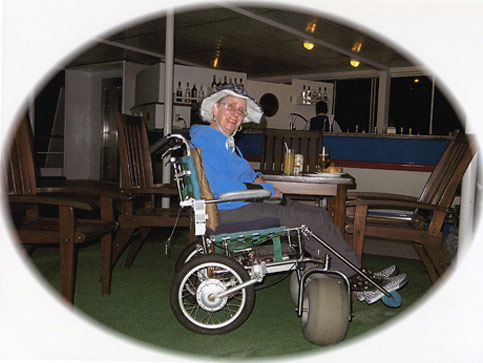
We freshen up, then head to the bar on the top deck (remember- this ship has an elevator). Here I get my first introduction to Jack Daniels whiskey. Though all drinks are included in the fare, I am the "Designated Driver" for the wheelchair and thus have only one glass. Nan drinks Sprite.
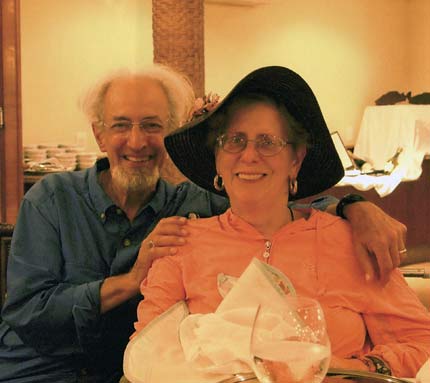
Then down to the bottom deck and the dining room. Tonight lobster is served. We are ready for it. Afterwards, activities are planned...
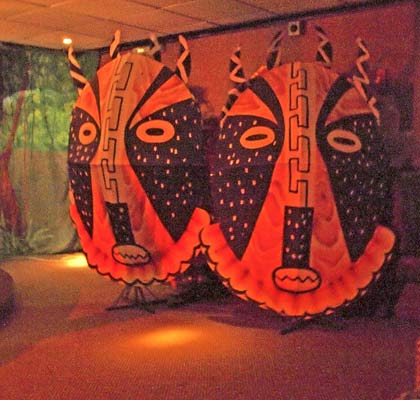
While we are at dinner, the downstairs lounge has been transformed into a cabaret. These masks at the entryway set the mood for what is to follow. A professional troupe has been brought aboard to furnish the evening's entertainment. As the scene opens, there are two samba groups dancing for us.
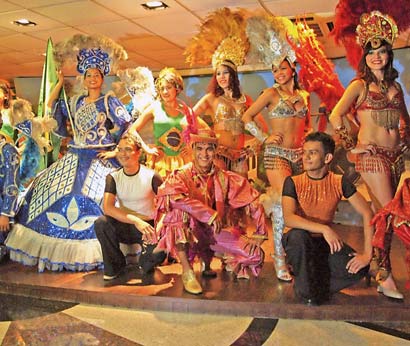
Samba, Carnival and all dance competitions in Brazil involve teams representing their particular region, neighborhood, tribe- or whatever. Their dances recall legends and "re-enactments" of true events, and are therefore quite different and original. The major contenders are usually the "Red Queen" and the "Blue Queen".
Above, the Red Queen is the rather scantily clad dancer on the far right of the photo. The Blue Queen, with far more clothing, is on the far left.
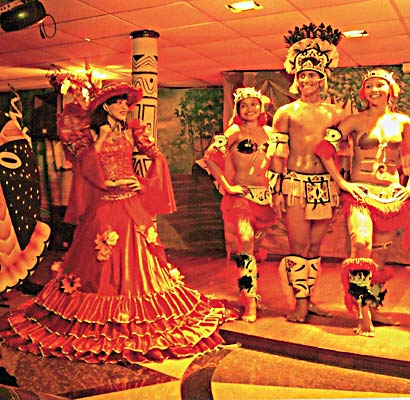
It is determined the Red Queen is the winner. She changes costumes and she and her court dance again for our pleasure. |
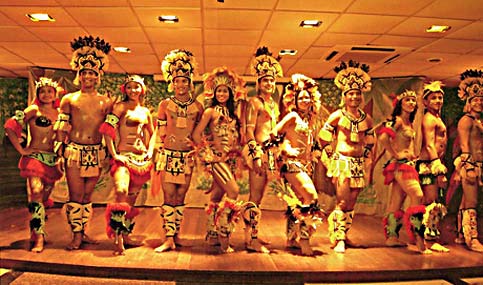
Then the entire cast re- unites for a final performance. There are some very attractive people in this- indeed, every ensemble of dancers throughout the country. All of them are in superb physical condition, and some of the competitions go on for days, with dancers going "full out" for hours without rest.
***********************************
Next day is a changeover day, a free day for us as we are continuing on for the second river. With our free day, we go ashore, through the harbor, and into the downtown area of the city of Manaus- 2 million people living along the Rio Negro, just above where it is joined by the Rio Solimoes. |
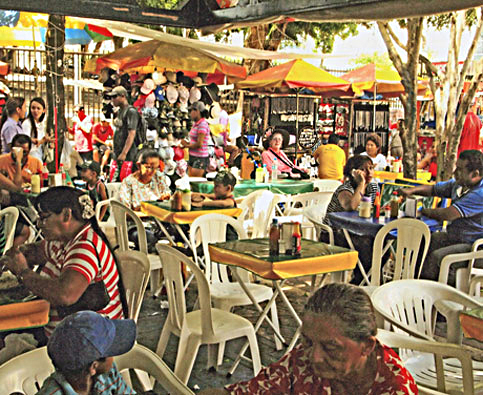
Photo: The throbbing central marketplace in Manaus, Amazon, Brazil
This is a city of more than 2 million people, representing 50% of the population of the Amazon. It dates back to the late 1700's but really came into its own when rubber became "The Industry" in the early 1900's, creating a class of industrialists as rich as Rockefeller and Andrew Carnegie- only in the Brazilian jungle.It is a lively, interesting place to visit, packed with shoppers.
Everyone in this square- with two notable exceptions, is local. (Hint: The lady in the pink shirt, seated at green table in middle of square is not). The native language is Portuguese; a few speak Spanish; fewer yet speak English.Yet, language is no problem and everyone is most cordial to us.
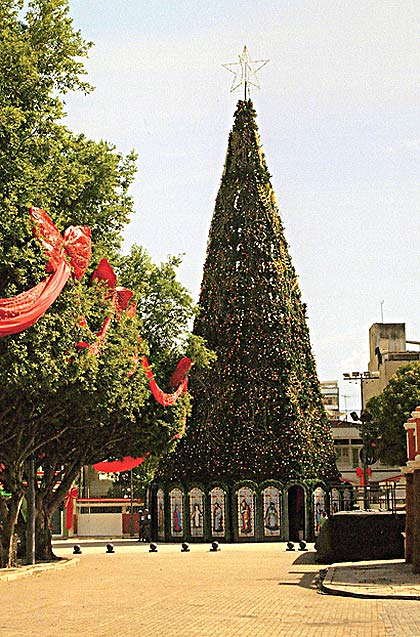
The temperature is around 100 degrees, with the same stifling humidity as everywhere else in Brazil. It is hard to think in terms of "White Christmas", ever harder when you consider being surrounded by dense jungle! The decorators have done a great job, though, and the mood is light and festive.
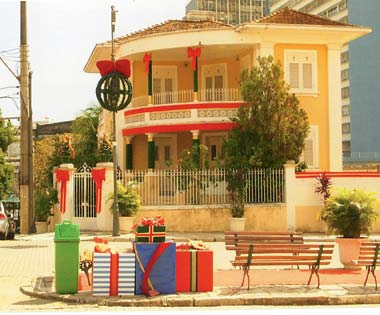
The Customs House, Central Plaza, Manaus, Brazil
The customs House and Christmas Tree sit on one side of the Plaza; a huge shopping area sits on another, with people selling all manner of things- some good stuff, some true junk. What kind of stuff, you ask? |
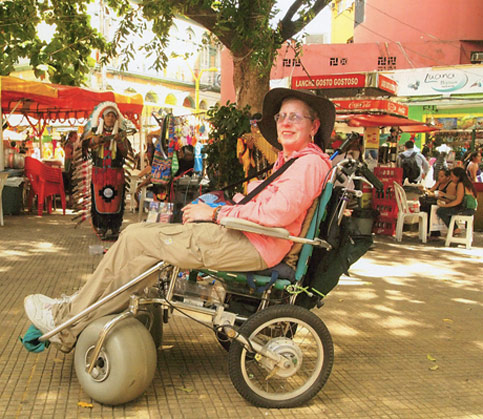
Well, how about buying a wooden flute or tomahawk from a fellow dressed in a full American Indian feather headdress? The mood is one of Christmas and holidays, so you don't find yourself concentrating on how "hokey" this must seem. It is energizing to be here. Besides, the famous Manaus Opera House is just around the corner.
**************************************
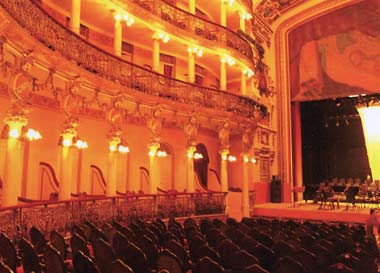
The Opera House is as elegant as La Scala in Milan. With its vast domes, gilded balconies and wrought iron grilles; with its marble columns and glass and crystal from Europe it is over the top.
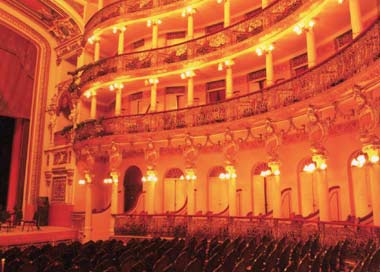
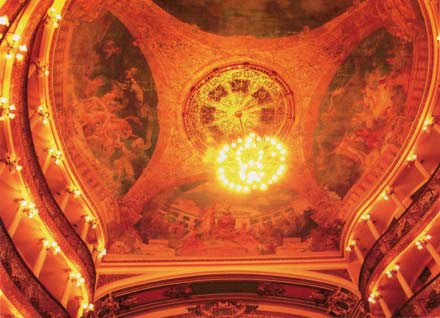
When the seeds of the rubber tree were smuggled out of the Amazon region, Brazil lost its monopoly on rubber production and Manaus fell into poverty. The boom in demand for rubber had brought electricity to the city before many European cities had electricity, but the end of the rubber boom made generators too expensive to run, and the city lost artificial lighting for years afterwards. |
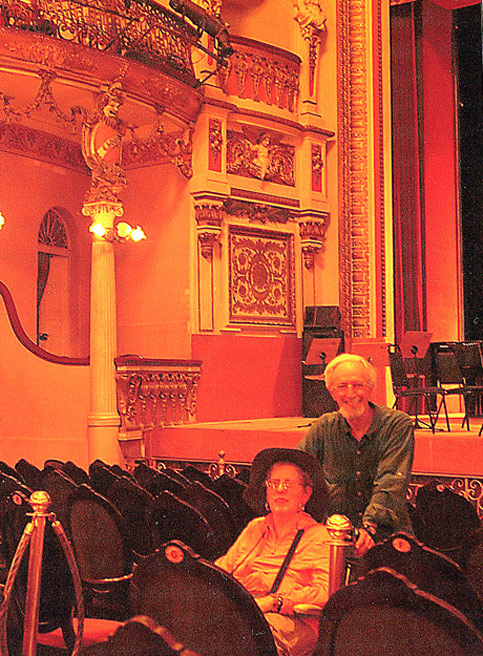
Now it has been restored. All the woodwork behind us has been hand carved. The scrollwork, banisters, grillwork and joinery represent skills either lost of in very short supply in our modern times.
The chairs you see are all fashioned from Brazilian mahogany, which were shipped to Europe for finishing then returned to Manaus for installation in the theatre.
Our guide tells us there is an opera to be presented this very evening, The Marriage of Figaro- one of my favorites- and there are tickets available. Pity, because our ship sails tonight, leaving port just at "curtain up".
********************************************
Walking back through town, we re- board the ship, excited about continuing our exploration- this time on the other river, the Solimoes, which will prove to be as different from the Rio Negro as night is to day.
In the morning, Agustus, the ship's manager, creates a special expedition for us. Having had time to re-think the problem, re- considers how he will load Nancy into the small boat. |
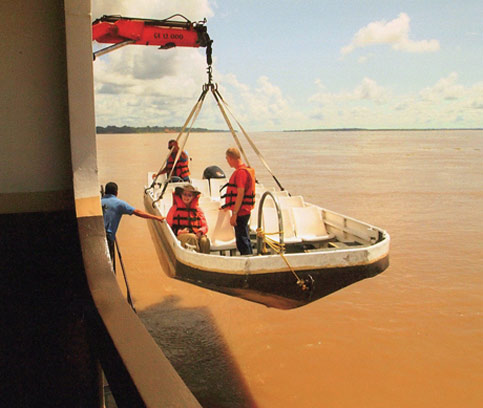
Augustus decides this time to use the ship's hydraulic lift to get Nan in and out of the water. Doing so ties up a large contingent of crew, but increases the safety margin considerably. We also learn this is a venture he has designed specifically for us alone in consideration of our special needs.
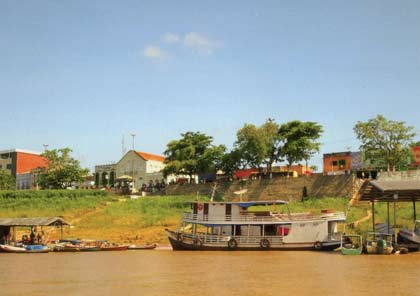
Photo: Life on the Solimoes is vastly different from life on the Negro
Here, there are towns, electricity, dishes for satellite transmission and Internet. Please note much less grass showing at the riverbank. This is because in the few days since we arrived, the river has risen many feet. Within a few weeks, it will rise another 20 or 30 feet and be up near the roadway where the houses are.
In contrast to daily activity on the Rio Negro, there is much greater activity along the Solimoes.
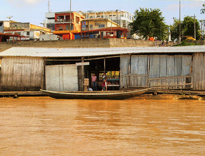
Photo of the general store upper left; School bus-boat on lower right
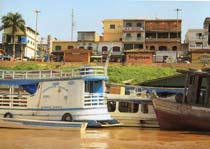
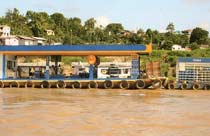
Above: your local gasoline station and auto tire supply store
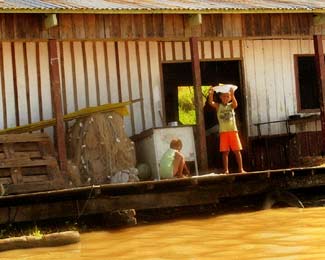
We pass a floating fish processing plant. The older boy runs into the shop and returns, holding a large fish over his head for us to photograph.
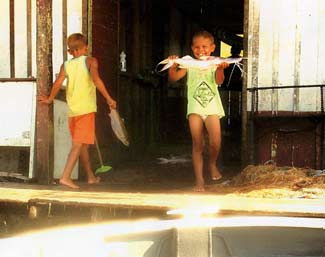
The younger brother jumps up, runs into the shop, and returns, beaming, as he hold up a larger fish! Fun is where you find it.
**************************************
Off on another adventure, several small boats leave the Mother Ship, heading for an afternoon of fishing. Our helmsman knows a few shortcuts, and takes a channel between the two rivers. Turns out it is a very busy route, with more traffic than we are accustomed to seeing.
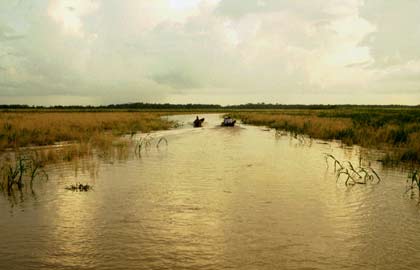
All around us, as far as the eye can see, there is only more grassland and some trees on scattered islands. It is starting to rain. Our guide reminds us that in a week or two, this channel and all the surrounding grass will be under water.
We continue up the channel, re-entering the main Solimoes River. Along the way, we are treated to life along its banks, "up close and personal".
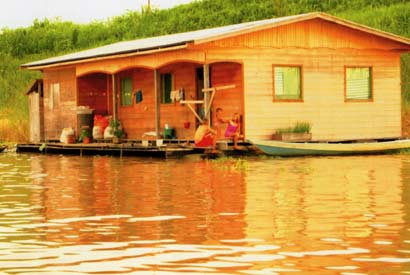
The rain has stopped. A mom and her kids are out on the deck of this charming house, playing.
The children wave enthusiastically at us, then return to whatever they were doing before we sailed by.
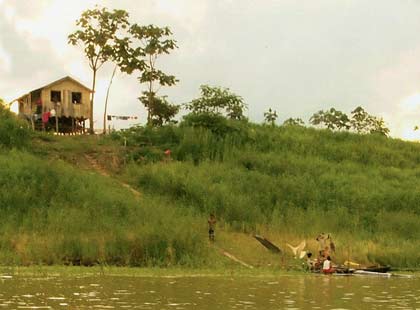
A more rustic house, built high off the river and on stilts for good measure. Remember, within a couple of weeks, the river will have risen to near the level of where the house is now.This afternoon, you can see the family washing clothes and simultaneously bathing in the river.
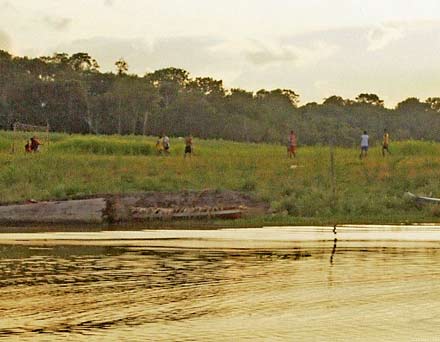
A little further up the river, we see "neighborhood" kids playing soccer. Don't know what they will do when their field is covered by water, but more than likely it will be something other than computer games.
Finally we reach our destination: A special location one of the guides knows is full of fish. We drop an anchor so the current will not move us, then everyone aboard gets a pole and bait.
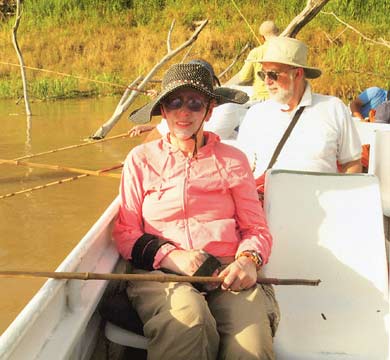
Never having fished before, Nan is somewhat confused. Her expression says, "What am I supposed to do now?" |
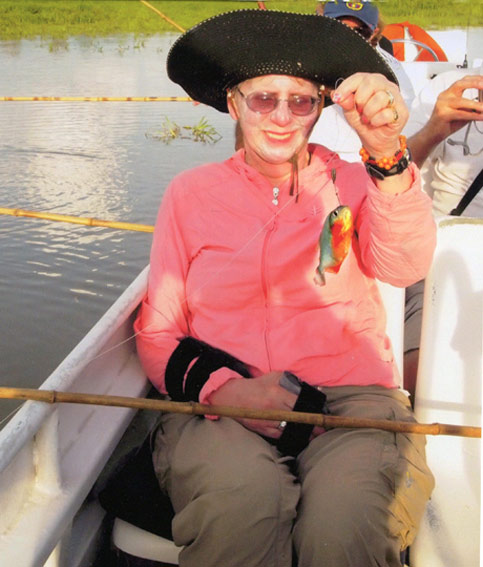
Photo: Unmistakable joy: Close up and personal with the piranha Nancy caught
This is a "catch and release" program, so the fish is taken off the hook and returned to the river. Some fish are kept in a pail of water to be used to feed the pink dolphins on the Rio Negro.
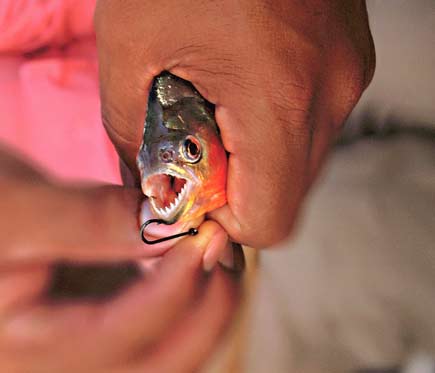
Piranha really could use a good press agent, because as it is, so much of what we "know" about them just isn't so. Their name comes from the native "pira", meaning fish, and "santha", meaning tooth. As you can see, that part is certainly true! Of the 40 or so different species, the red-bellied ones- like the one Nan caught- are the most feared.
With powerful jaws and razor sharp teeth, they shred flesh from bone with amazing speed and efficiency. Like sharks, they are instantly attracted to the scent of blood. Although they will aggressively attack anacondas, manatees and other life in the water, unless you have an open wound- or are bleeding- they will not attack humans. Here's proof:
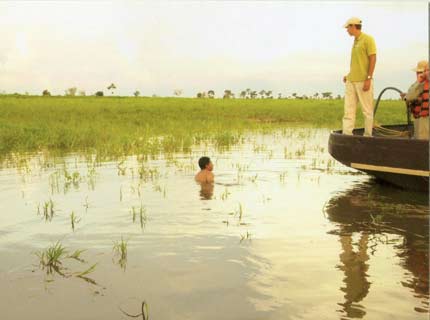
Piranha will attack one another, but (they say) unless there is blood in the water- or they are trapped or starving to death, piranha will not attack a human. This was proved to us by one of the guides who dropped into the river to swim just after we finished fishing! Fine for him, but we wouldn't do it!
*******************************
About the ship:
In doing our preliminary research, we discovered there is only one ship, Iberostar's "Grand Amazon", which has an elevator, sufficient staff, and equipment capable of dealing with someone in a wheelchair.
She is comfortable to live aboard, but in a wheelchair, you cannot consider the vessel handicap accessible. Doorways are too narrow, and there are lots of compartment barriers you cannot cross without assistance. Immediately as we came aboard, I was afraid I had made a horrendous mistake. |
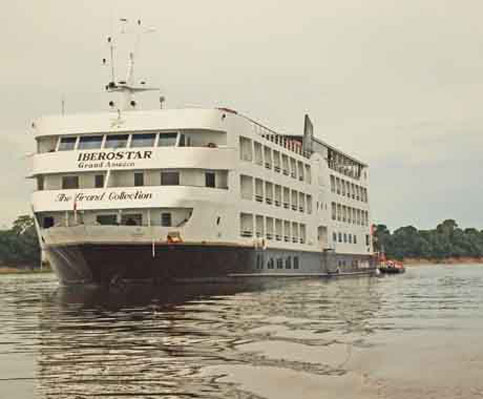
I figured out a way to get Nancy into the cabin and the bathroom (which had a roll in shower), but it was the ship's general manager, Augustus, his caring attitude and willingness to help- as well as the attitude and willingness of his crew- that made our adventure possible- even wonderful!
They carried Nancy across every barrier, loaded her into excursion boats, did everything they could to make our adventure happen. When jungle treks and visits to native houses were scheduled for non-challenged passengers, Agustus made separate arrangements for us, and Nancy and I were taken elsewhere, privately, in a boat with two of the crew to care for us. |
The staff was never under obligation to do any of this, but they did it anyway. We have found this to be true in our travels across the world: You can always find people who are generous with their assistance, helpful and willing to do what they can to ease the path of someone who is physically challenged. |
Before we went on the Amazon cruise, we spent a week visiting Rio de Janeiro, Brazil. You can read more about our experiences in Rio, as well as the day we spent in Manaus, in the chapter on Brazil. |
|
Have you checked the most important parts of our website? We urge you to go to the Chapter on Essential Plans. Then, whether they apply to you or not, read the Chapters Airlines, Cruises, Hotels, Taxis, Tours. Finally, be sure you read the Chapter Items to Take. The information in these chapters will make all the difference in the success of your trip.
|
Contact Us
Please feel free to contact us if you have questions, suggestions, comments or just some friend words by clicking on our contact form |
Please go to our Disabled Travelers Guide to the World for many additional tips on arranging tours, transport and other details. See, especially, Chapter 8- About Tour Guides. There is also valuable information in Chapter 12- About Bargaining and Negotiating. |
|
|
|