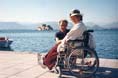
"Stick her in front of a TV," they told me. "It won't be very exciting, but at least it will keep her occupied."
That's the advice I was given after a team of neuroscientists examined and evaluated Nancy a year or two after her strokes in 1987. Not a great prospect for the future- hers or mine!
I decided to discover ways to give more meaning to our life together. And to do this, further decided we would travel the world. By 2003, we had taken some pretty enjoyable trips, but this one, to Antarctica, would become the 'turning point' in our lives- the time that Nancy discovered a purpose for living she could use or the rest of her life.
In 2003, no large cruise ships sailed the Antarctic waters as they do now. In fact, beside a Russian icebreaker, there were only a few other ships equipped with reinforced hulls that sailed the area. Fewer than 10,000 people had traveled there, so difficult and remote was this vast area. We decided to try and do it.
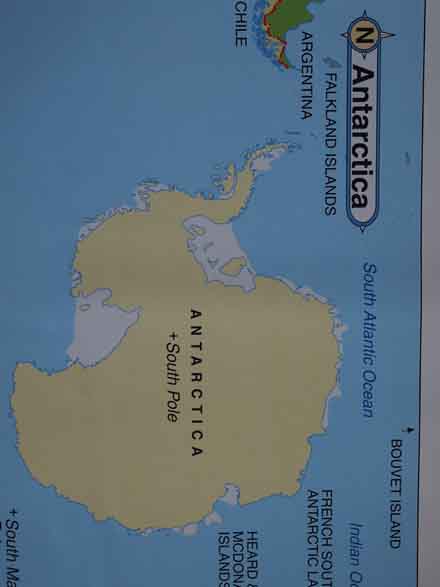
We have put the map here, turned to orient it as you are used to seeing it on a globe or map of the world. All of South America is above this picture. Only a relatively small distance of water separates South America and Antarctica itself. Unfortunately, this small distance, known as the Drake Passage, hosts what can be the world's roughest patch of sea. The week before we sailed, the ship encountered a storm with 40 foot waves! For our passage south, seas were rough, but nowhere near forty feet- enough, however, that Nancy was seasick on the night they served lobster.
Of all the places we have visited, Antarctica is perhaps the most special for us. Nancy calls it the “Magical Place”. It is unlike anywhere else on Earth and thus it
is impossible to compare it to any place you have ever been before.
When we first started to plan this trip, no one we spoke to could understand why we wanted to go there. Everyone assumes it is a cold, uninteresting landscape, monochrome white color.
They assume nothing interesting lives there and there is nothing interesting to see or do there.
Antarctica turns all such assumptions on their heads. Clean, breathtakingly beautiful, almost mysterious, with legends and rituals unmatched by anyplace else on Earth; so vast in size it will take you a couple of days to begin to get the frame of the place into your mind.
Almost a hundred years ago, the famous explorer Ernest Shackleton sailed here. His ship, a vessel made of wood, was caught and crushed by the freezing water. Our ship, all metal with a reinforced outer hull to permit it to break ice, will not suffer the same fate as Shackleton.
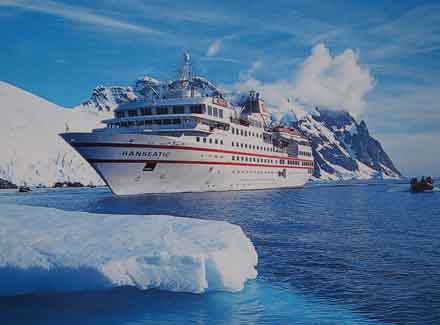
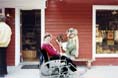
The Hanseatic is a small ship (184 passengers) operated by Hapag-Lloud, in no way to be considered handicap accessible, but the captain and crew could not be more accommodating and helpful. They carefully got Nan on and off the boat at nearly every port of call.
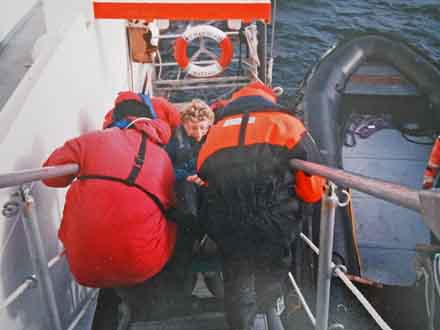
Photo: First time descending stairs was truly scary- both for us and for the crew
Meanwhile, back to Ernest Shackleton: with his boat crushed, Shackleton and his crew had to abandon it. He left Frank Wild in command while he, Shackleton, went off in an open row boat to find rescue. He was successful! You can read of Shackleton's exploits here.
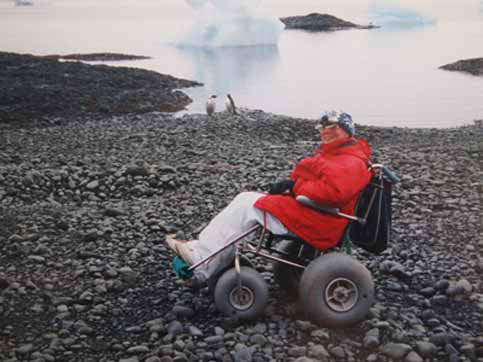
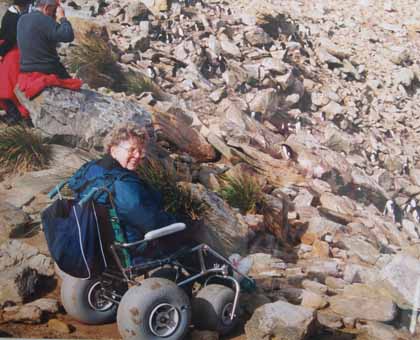
Nancy is the first woman in a wheelchair to set foot on the spot where the rescue took place.
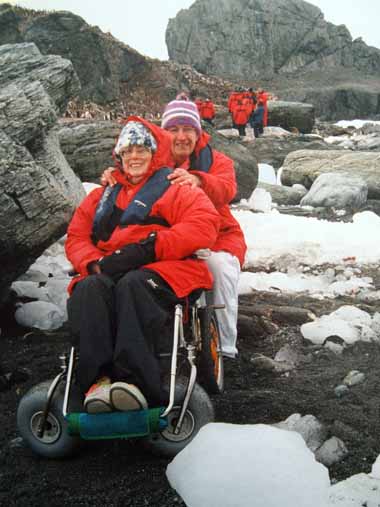
It took a lot of help for us to get here, and a lot of help to get Shackleton and his men out of here. It was worth the effort on both parts!
Right behind us is the memorial to the Captain Luis Pardo, who skippered the Chilean vessel "Yelcho", and saved the members of the Shackleton expedition.
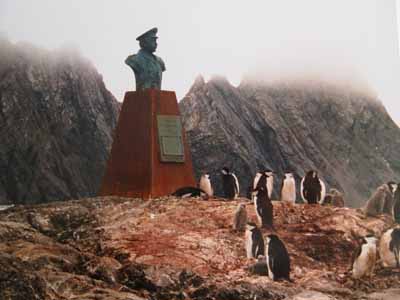
Photo: Unfortunately, only a few penguins see the memorial to Captain Pardo
The serenity of this vast continent is nearly overwhelming. Think of it: no fast food restaurants anywhere. No shopping malls- because, by International agreement, no commercialization of any kind is permitted here. Less pollution than you will find
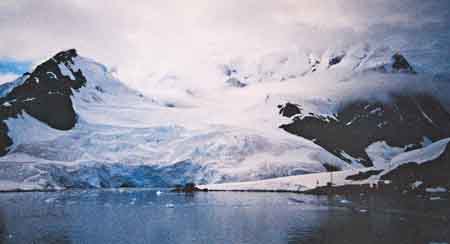
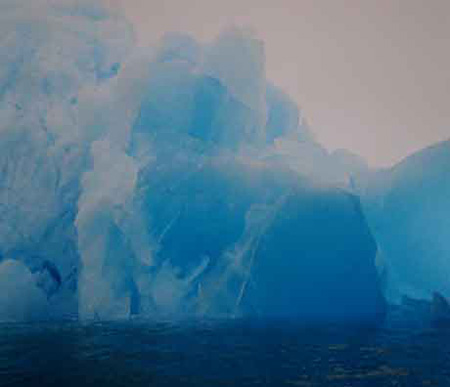
anywhere else in the world, which permits you to look up into the sky and see more stars than you can possibly comprehend. Just as incomprehensible are the icebergs and ice floes. This one had to tower several hundred feet above us.
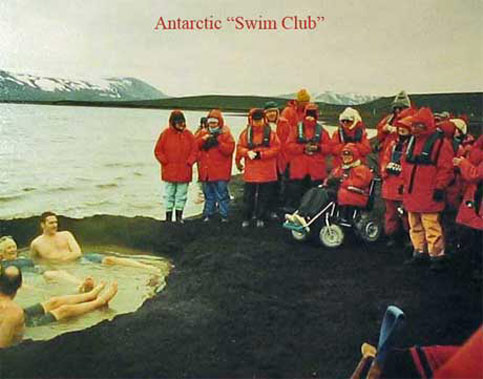
There are a number of traditional, special initiation "rites of passage" limited to those special people who have set foot on the Antarctic Continent. One such is joining the Antarctic Swim Club:
|