|
 |
KENYA |
 |
|
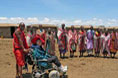
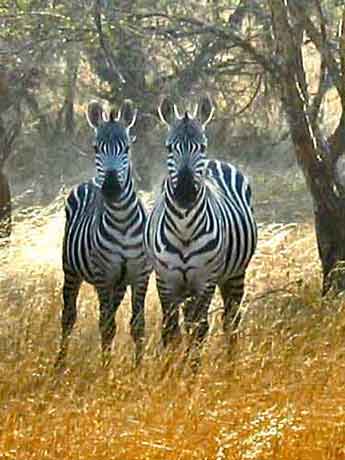
Sister and Brother stop to stare at us in Kenya
|
In Central Africa sits Lake Victoria, the second largest fresh water lake in the world (Lake Superior is the first). The largest lake in Africa, Victoria is the source of the water that forms the Nile River. Clustered around this enormous lake are four nations: Uganda, Rwanda, Tanzania,
and Kenya.
Loving wildlife as Nancy and I do, there is probably no other place on Earth where you can go on African safaris and see so many animals of so many different breeds in such a well maintained natural eco system.
Tanzania and Kenya share a common border in an area famously known as the Serengeti Plain. In July and August, the grass is exhausted in the southern part of the Plain, the part located in Tanzania. Thus
the animals who have been feeding there now migrate north to Kenya. Millions of Wildebeest make this migration, along with Zebra (and numerous predators who prefer to eat the zebra and wildebeest rather
than grass).
We flew from Entebbe, Uganda to Nairobi, the capitol of Kenya. Transferring from the International Airport to a smaller, regional airport, we pushed and pulled ourselves into a single engine, four seater
plane, and headed out for the safari camp we would occupy while in Kenya.
Flying over a chain of volcanoes, we climbed to 6000 feet, but most of the time we were flying not much above the tree tops. We watched hundreds of square miles pass beneath us, most of it parched and absent vegetation. Every once in a while, where there was a river,
green spread out as far as the moisture permitted. Then more parched land.
The bush camp where we stayed is located on the Maasai Mara preserve, in Kenya. It is a continuation of the much larger great Serengeti system, which lies in neighboring Tanzania.
We had three, especially noteworthy experiences while in the Mara:
1) Many of the Maasai, world renown warriors, are nomadic, traveling with their tents, families and animal herds, following the food supply. Many, however, have set up permanent villages, and preserve
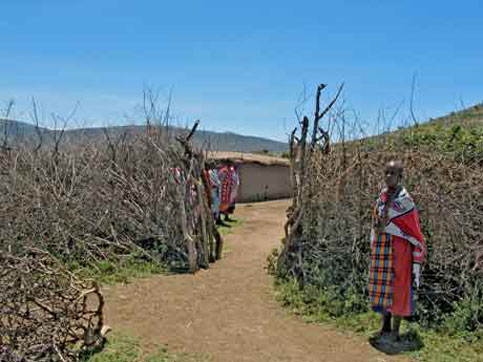
the same lifestyle in all other respects. They build their homes inside a ring of sticks around their village, bringing their animals inside the ring at night to protect them from predators. This is successful
to a degree, but loss of animals is a regular event. |
|
Entrance to the village. It is fenced to keep out large predators.
|
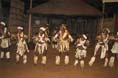
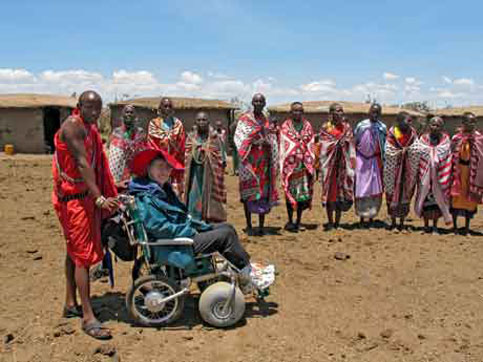
The entire village turned out to greet us, all members beautifully dressed in traditional clothing, robes freely flowing, vibrant colors swirling in the gentle wind. |
|
The welcoming committee, starting with the chief and his wives.
|
We spent a day in such a village, an event remarkable because the lifestyle is so foreign to us. We met the village chief, who kindly hosted me into his house, a structure whose doorway was too narrow
for Nancy to enter. In fact, I had to turn sideways to get inside it. The doorway is specifically designed to discourage lions and large cats from entering while everyone inside is asleep. |
|
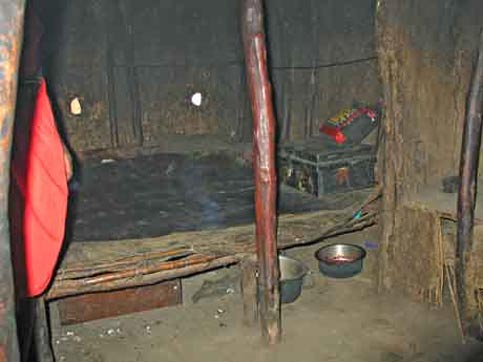
The chief's house. Spartan by any standard. Two of three "windows" are over the bed where the chief and one of his several wives sleep. Some animals sleep behind the partition on the right side, furthest from the entryway.
|
|
The place had only three small windows, better described as portholes, and a small hole in the roof from which smoke could escape during cooking. It was quite warm outside, but positively roasting
inside. There was a large pot, a few cooking utensils, no furniture except for the bed frames, no electricity, and certainly no running water.
The chief and his wife (some tribesmen have more than one wife) slept in one corner of the place; his two children slept in another, while several of the animals he owns slept in a third part. The entire
place could not have been more than ten or twelve feet square.
I asked our guide about marriage customs and about having more than one wife. He told me a man may have as many wives as he can afford. They use animals instead of money, and bargain for their purchase:
An ugly, older woman might be purchased for, say, three chickens. A woman who is plain but not ugly might be secured for two chickens and a goat. A young, attractive girl might cost several water buffalo, a great value in their economy.
Tourism and safaris provide most of the source of hard currency in this region. All of the Maasai who work as guides far prefer living with their tribes, doing customary tribal activities rather than living and working in an environment somewhat like ours.
When I asked why they were working, they said, flat out, it was for the money.
When I asked what they would do with the money, considering they live in an essentially cash-less society, largely devoid of “things”, every one of them who was unmarried told us it was so
they could purchase animals and then bargain the animals for a wife.
Those who were already married, but childless, told us they would use the money to purchase animals and then bargain for an additional wife.
Those who were already married and had children told us they would use the money so they could educate their children.
Schooling is not provided by the government in Kenya. Most of the schools are church affiliated, and are fairly pricey. Uniforms must be purchased. Textbooks and school supplies must all be paid for with
cash, as the schools, unlike prospective fathers-in-law, will not accepts chickens, goats, or water buffalo.
*******************
2) The second noteworthy experience involves a day we spent at the medical ‘clinic’ serving the village we’ve just described, and several other villages in the area as well.
The word clinic has quote marks around it, because the facility was little more than a first aid station, not really what we would think of as a nicely equipped, fully functioning medical establishment.
There was one autoclave for sterilizing instruments, but I think it was broken. There were only enough antibiotics to treat three patients for four days.
And four, young, frustrated doctors, frustrated because there was so little they could do for those who came to them seeking help.
I asked one of the doctors what was the cause of most of the health problems they treated. Without hesitating for even a fraction of a second, he replied,
“Lack of clean water.” That, and they fact that most of the villagers slept with dirty animals practically in the same bed.
3) The last noteworthy experience involves the day we spent, spellbound, as we watched the migration of animals cross the Mara River to reach fresh grasslands.
We arose quite early this day.
Our camp was located nearly three hours drive from the closest crossing point. The guides know the animals usually cross only once each day, usually starting around 1PM. Thus, to get the best position
for viewing this spectacle, it is necessary to arrive at the crossing point by 12:15PM, the latest. We were there by noon, and our superb guide secured the premier location, allowing us an unobstructed
view of the entire process.
En route to the river, we passed unceasing herds of animals, the herds growing larger and ever more numerous the closer we got. Within perhaps three miles of the river, there were clusters and strings
of animals as far as the eye could see.
At river’s edge, hundreds of animals had already gathered, but none had entered the water. The overwhelming majority of animals were wildebeest, the remainder, zebra. Over the course of the next hour or so, more and more animals gathered,
squeezing closer and closer in the limited space, until there were several thousand pressed together, all waiting for one of them to enter the water and cross. One would start, then pull back. Another would try. The zebras, more clever than the Wildebeests, would try to lure the dumber animals into crossing the water. Then, they would sneak back into the crush of surrounding animals, hoping the stupid Wildebeest would continue forward.
Finally, one did. Then several more. Then, as a dam bursting under too much pressure, so many animals entered the water they were literally leaping onto one another’s back. We watched in total fascination
for the next hour and a half as thousands of wildebeest and zebra crossed. Our guide estimated as many as five thousand.
And then, as suddenly as it had begun, it stopped. It was as though a switch had been thrown. Something "spooked" them, and the animals still on our side of the river slowly turned and backed away. They would re-assemble tomorrow, gather exactly as they had done today, and
repeat the process each day, again and again, until no more animals were left to cross.
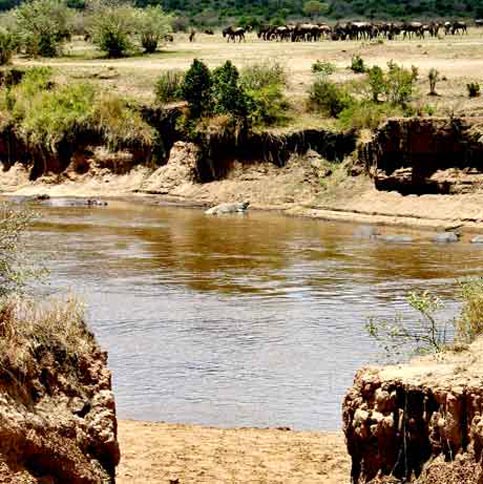
Only one animal not make it. A young wildebeest was taken under water by a crocodile, so swiftly that we really didn’t see it happen as much as we realized there was an animal at that spot
one instant and the next instant, he was gone. |
|
A large crocodile, full from lunch, ambles to the far bank to digest his meal.
|
|
|
We have been told that we were quite fortunate to have visited when we did, because the animal population is rapidly dwindling. Human encroachment on their habitat, coupled with Global Warming causing a serious reduction in water supply, is threatening the entire area. This is a most unforgiving area, with no Plan B in place to save it. Sadly, we heard the same thing about the Polar bears and Antarctic wildlife.
***********************************************
Transiting back to our more familiar form of living, we stopped overnight at the famous Giraffe House just outside Nairobi. It is an old mansion, now given over as an animal sanctuary, especially giraffes- of which there are a number on the extensive property.
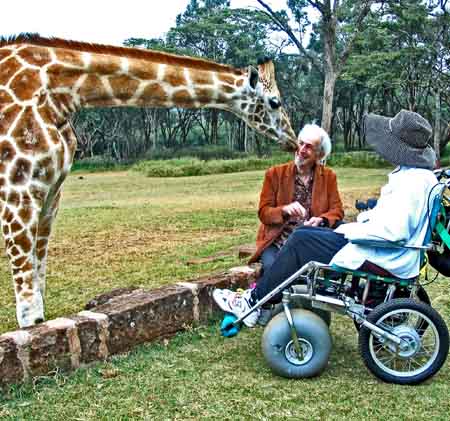
Sitting outside on the lawn, just after breakfast, one of these friendly fellows came over to "chit-chat". The management had given us the special pellets of "Giraffe Food" which this guy devoured in seconds. Their tongues are very rough, but they are most gentle and we loved the interaction! |
|
Have you checked the most important parts of our website? We urge you to go to the Chapter on Essential Plans. Then, whether they apply to you or not, read the Chapters Airlines, Cruises, Hotels, Taxis, Tours. Finally, be sure you read the Chapter Items to Take. The information in these chapters will make all the difference in the success of your trip. |
Contact Us
Please feel free to contact us if you have questions, suggestions, comments or just some friend words by clicking on our contact form |
|
| |